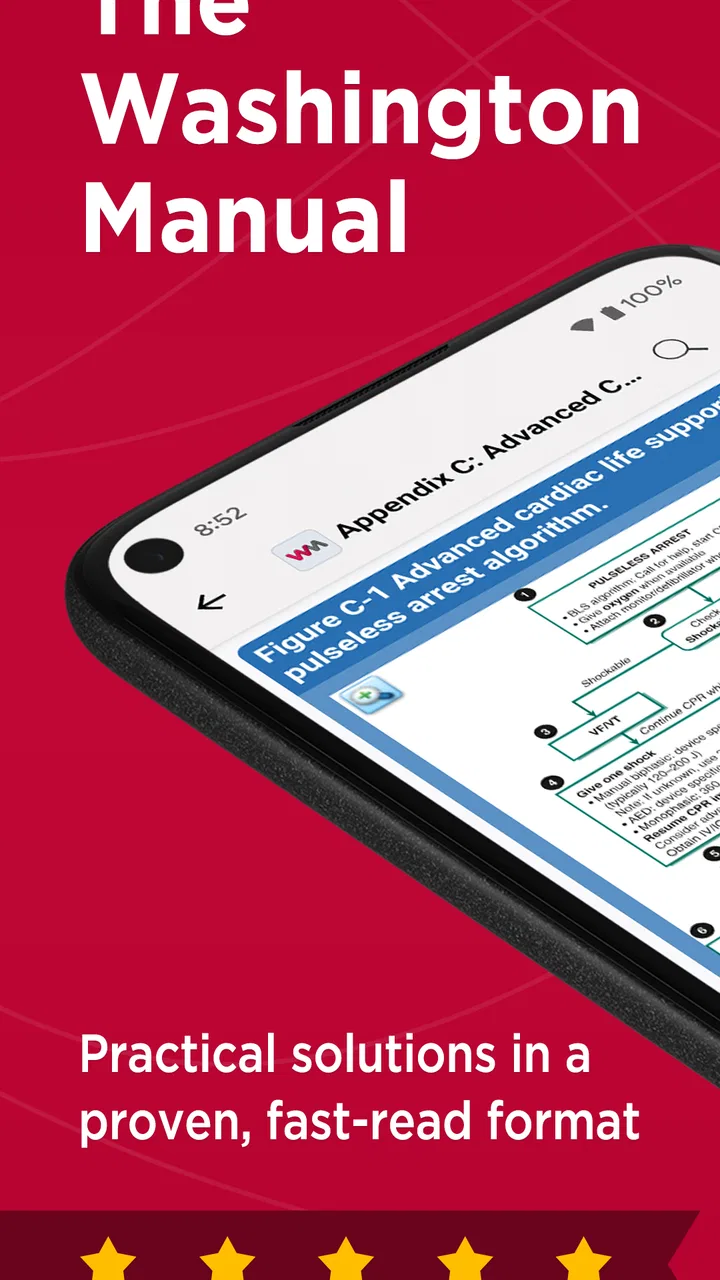
The Washington Manual
- 4.9
- Rating
- 10.00K
- Installs
- Free
- Price

 Analysis by App-foxy
When I need a compact medical reference rather than a general health app, The Washington Manual is the kind of tool I would keep close. It is built around the Washington Manual of Medical Therapeutics, and that focus makes its value quite different from a symptom checker or a broad medical encyclopedia. I found it most useful as a quick point-of-care reference: something to consult when I already understand the clinical question and need a dependable way to orient myself before checking a fuller source.
This is a free medical app from Unbound Medicine, Inc, with an Everyone age classification. Its average rating is 4.9 from around 180 ratings, and it has passed 10K+ installs. Those figures suggest a small but highly satisfied audience rather than a mass-market health product. The app was released on November 7, 2013, and its current version is 2.8.52, so I see it as an established reference product rather than a new experiment.
How The Washington Manual feels in real use
I find the most useful way to judge The Washington Manual is to separate confidence in a reference from confidence in a clinical decision. Its focused therapeutic scope can help me frame a question, but the responsible next step is still to check the context and use the appropriate current guidance. That distinction matters most when a quick lookup could influence care, and it leads naturally to the question of what users can actually verify about the app’s controls.
You May Also Like

 Pandora - Music & Podcasts
Pandora’s Music Is Easy to Start, but Harder to Recover
Pandora’s strength is its low-effort path from a seed to a station. Its weak spot is how much confidence it asks you to place in connection, setup, and quiet recovery.

 8 Ball Pool
 Is Built on Rivalries, Rematches, and Routine
A close look at the rivalries, rematches, shared routines, and unanswered safety questions that turn a quick pool match into a persistent mobile community.

 Samsung Music
’s Quiet Strength Is Playing What You Already Own
Its reach comes less from spectacle than from dependable access to a personal library. That simplicity is both the app’s strongest retention engine and its ceiling.

 AccuWeather: Weather Radar
AccuWeather Review: A Quick, Clear Forecast for Everyday Decisions
For everyday plans, the best forecast is the one you can understand quickly. AccuWeather makes rain timing, radar, and local conditions easy to act on, with a few trade-offs.

 Hill Climb Racing
Why Hill Climb Racing Still Turns Crashes Into One More Run
A tiny car, a bumpy hill and one more upgrade: Hill Climb Racing keeps resurfacing because its simple chaos makes every near-miss feel personal.

 AliExpress - Shopping App
AliExpress Makes Global Shopping Feel Personal, but Shoppers Bear the Risk
AliExpress turns a global marketplace into a pocket-sized discovery engine. Its reach is useful, its shopping loop compelling, and its trade-offs easy to miss.
More From Our News Desk
View All News


Speed expectations when you need an answer quickly
The main performance question here is not whether the app behaves like an action game or a social feed. It is whether I can move from opening the reference to locating the relevant medical topic without unnecessary friction. For that purpose, the focused scope works in its favor. A dedicated therapeutic manual is easier to approach than a giant library containing unrelated specialties, wellness articles, and consumer-facing explanations.
I would expect the app to feel most responsive during short, deliberate sessions: opening it to confirm a treatment-related point, reviewing a familiar section, or refreshing my memory before discussing a case with a colleague. The experience is naturally more efficient when I already know the clinical area I want. If I am unsure whether my question belongs under a disease, a drug, a symptom, or a treatment plan, the search process may require more thought than it would in a general web search.
That distinction matters. The Washington Manual is not designed to replace clinical reasoning with a single answer. It is a reference for narrowing the path to useful information. I would not judge it by how quickly it produces a reassuring sentence for a worried patient; I would judge it by how quickly it helps a medically trained user revisit a therapeutic topic in context.
One practical habit improves the experience: I would open the app before entering a busy clinical situation and make sure I know how its navigation is organized. A reference tool becomes much more valuable when the user already understands its structure. Searching while distracted, with no idea whether to begin from a condition or a treatment topic, can make even a well-focused resource feel slower.
What happens during heavier reference sessions
Short consultations are only part of the picture. A medical manual can become demanding when I move through several related topics, compare treatment approaches, or keep returning to the same section while building a broader understanding. In those moments, the important issue is not just opening speed. It is whether the app remains comfortable to navigate and whether I can recover my place after switching attention to another task.
I would use it in layers rather than trying to read an entire subject in one sitting. First, I would locate the relevant therapeutic area. Next, I would identify the specific point I need to verify. Finally, I would return to the surrounding context so I do not mistake an isolated detail for a complete recommendation. This workflow reduces mental load and makes the app more useful than treating it as a collection of disconnected snippets.
The trade-off is that a specialized manual may feel less convenient for broad learning. If I wanted a long explanatory lesson, patient-friendly language, or a visual overview of a complicated condition, I would choose a different resource. The Washington Manual is stronger when I have a defined question and weaker when I want the app to teach the entire subject from the beginning.
Another realistic heavy-use scenario is exam or rotation preparation. I could use the app to revisit therapeutic principles between study sessions, but I would not rely on it as my only learning system. A manual can support recall and clinical orientation; it does not automatically provide the practice questions, lectures, diagrams, or case-based feedback that many learners need. Its best role is as a focused companion to a wider study plan.
Reliability, confidence, and the need for judgment
The high average rating is encouraging, but I would not confuse user satisfaction with a guarantee that every clinical decision can be made from the app alone. Medical treatment depends on patient-specific factors, local practice, current guidance, contraindications, and professional judgment. A reference can help me ask better questions without becoming the final authority for an urgent decision.
That is especially important because the app belongs to the medical category, not the general wellness category. I would recommend it to students, trainees, clinicians, and medically knowledgeable readers who understand how to interpret therapeutic information. I would not recommend using it as a self-diagnosis shortcut or as permission to change medication without speaking to a qualified professional.
For reliability in everyday use, I would build a simple verification routine. I would check the relevant section, read enough surrounding material to understand the context, and then confirm any high-consequence decision against the appropriate current clinical source or supervisor. This is not a criticism unique to this app; it is the responsible way to use any medical reference, particularly when a patient’s circumstances do not match a textbook example.
The app’s long presence in the market also gives it a sense of continuity. At the same time, its release history means I would pay attention to the current version and to the date of any medical information I am applying. The current version is 2.8.52, but a version number by itself does not tell me whether every topic matches the latest guideline in my region. I would treat the app as a useful reference layer, not as a substitute for checking time-sensitive recommendations.
Device constraints and the cost of choosing this reference
The minimum operating-system requirement is iOS 9, which makes the app accessible to a wide range of older compatible devices. That is helpful for users who keep a dedicated phone or tablet for study and clinical references. It also means the app is not demanding the newest hardware simply to perform its basic role. For a text-centered manual, that is a sensible advantage.
Still, an older supported operating system does not guarantee identical behavior on every device. Screen size, available storage, multitasking habits, and the condition of the device can all affect comfort. I would prefer a larger screen for longer reading, while a phone is more convenient for a quick lookup. On a smaller display, dense medical material may require more scrolling, which can make comparison between nearby sections less comfortable.
Resource demands are likely to matter most when the app is used alongside several other demanding applications. I would close distractions before a study session, keep the device reasonably charged, and avoid assuming that a reference app can replace a full desktop workflow. Those are ordinary precautions, but they make a difference when I need to move between the manual, notes, a calculator, and another clinical resource.
The free download is attractive, particularly for students deciding whether a dedicated reference belongs in their toolkit. However, the app includes in-app purchases priced from $79.99 to $99.99 per item. That changes the decision considerably. I would inspect exactly what the available purchase unlocks and compare it with the references already provided by my school, hospital, library, or professional organization before spending that amount.
In other words, “free” describes the entry point, not necessarily the complete value proposition. Someone who only wants to explore the app may be satisfied without paying. Someone who needs the full therapeutic content should make a deliberate budget decision. The purchase may be worthwhile for a frequent user, but it is harder to justify for someone who consults medical references only occasionally.
Who will benefit, and who should choose something else
I see the strongest fit for medical students, residents, nurses, physician assistants, and clinicians who want a focused therapeutic reference in a portable format. It is also suitable for a learner who prefers concise consultation over browsing a general search engine. The app’s subject focus helps keep attention on treatment rather than sending me through unrelated consumer-health material.
I would be more cautious about recommending it to a patient or family member looking for a plain-language explanation. The title and medical orientation signal a professional reference style, and that can be unnecessarily dense for someone who simply wants to understand a diagnosis. In that situation, a patient education source written for non-specialists would probably be clearer and safer.
I would also steer away from it if my main goal were medication reminders, appointment management, symptom tracking, telehealth, or emergency guidance. This is not a general personal-health organizer. Its usefulness comes from its therapeutic reference role, so choosing it for unrelated tasks would create disappointment before the first serious lookup.
Compared with a web search, the manual offers a more focused route and less temptation to trust the first attractive result. Compared with a broad medical database, it may feel easier to approach because the subject is narrower. Compared with printed manuals, the app is more portable and searchable, although some readers may still prefer paper for extended reading and annotation. Compared with institution-provided clinical tools, it may be less integrated into a local workflow, particularly when a hospital requires its own approved references.
Three practical ways I would use it
My first workflow would be a pre-round refresher. Before seeing patients, I would choose one therapeutic area relevant to the day’s cases, review the surrounding section, and note the questions I still need to ask. The value is not memorizing every line. It is arriving with a clearer framework and recognizing where patient-specific details could change the plan.
My second workflow would be a “context before conclusion” rule. If I searched for a particular therapy, I would avoid stopping at the first matching phrase. I would read the nearby material, look for qualifications, and then confirm whether the patient in front of me fits the situation described. This is a small habit, but it prevents a quick reference from becoming a dangerous shortcut.
My third workflow would be using the app as a bridge between a question and a primary source. I would consult the manual to identify the relevant terminology, then use that terminology when checking a current guideline, institutional protocol, or supervisor’s advice. This makes the app valuable even when it is not the final source I cite. It helps turn a vague concern into a precise clinical question.
A fourth useful approach is to separate learning from urgent action. During study time, I can read broadly and compare related topics. During a time-sensitive situation, I should use the shortest safe route, verify critical information, and involve the appropriate professional authority. The app is better when I respect that boundary instead of expecting one reference to perform every job.
My performance verdict
After considering speed, heavier sessions, reliability, and device limits, I see The Washington Manual as a focused medical reference with a clear audience. Its strongest quality is concentration: it gives medically oriented users a direct place to revisit therapeutic information without the noise of a general health platform. That focus can make everyday lookups feel efficient, especially when I already know what I am trying to investigate.
Its limitations are equally important. It is not the right tool for patient-friendly education, personal health tracking, emergency decisions, or broad interactive learning. The in-app purchase range also means I would not judge the free download without first understanding how much of the useful content is available at no cost. For occasional users, a library or institution-provided alternative may offer better value.
The app’s 4.9 average and 10K+ installs show that it has earned strong approval among its audience, but the audience itself appears specialized rather than universal. I would recommend trying the free version first, testing the navigation with the kinds of therapeutic questions I actually face, and only then considering a purchase. That approach avoids paying for a reference that does not match my study style or professional needs.
My final view is positive but measured: The Washington Manual is most effective as a fast, portable companion to clinical judgment, not as a replacement for it. If I were a medical learner or practitioner who wanted a dedicated therapeutic manual on an iOS device, I would give it serious consideration. If I wanted a simple health app for everyday personal use, I would skip it and choose something designed around that purpose instead.
For the right reader, the app earns its place by reducing the distance between a focused medical question and a structured reference. Used carefully, it can support preparation, revision, and responsible follow-up. The key is knowing what it is: a specialized tool from Unbound Medicine, Inc, useful precisely because it does not try to be every kind of health app at once.
FAQs for The Washington Manual
01What is The Washington Manual app?
The Washington Manual app is a digital clinical reference based on the well-known Washington Manual of Medical Therapeutics. It is designed primarily for medical students, residents, physicians, nurses, and other healthcare professionals who need quick access to practical information about diagnosis, treatment, and inpatient care. Its content is organized for fast consultation rather than casual reading, making it especially useful during study sessions, clinical rotations, or hospital work.
02What kind of medical information can I find in The Washington Manual?
The app generally covers a broad range of internal medicine topics, including common diseases, symptoms, diagnostic approaches, treatment options, medication considerations, and hospital-based management. Depending on the edition and subscription available, users may also find tables, clinical algorithms, laboratory guidance, and specialty-focused chapters. The exact features can vary between versions, so checking the current store description and edition details before downloading is recommended.
03Is The Washington Manual suitable for medical students and beginners?
The Washington Manual can be very helpful for medical students, particularly those who already understand basic medical terminology and want a concise clinical reference. However, it is not intended to replace textbooks, lectures, supervised training, or advice from qualified professionals. Beginners may find some sections dense because the material assumes a healthcare background. Students should use it as a study and review aid while confirming important information with instructors and current clinical guidelines.
04Does The Washington Manual app require a subscription or payment?
Access conditions depend on the platform, publisher, edition, and region. Some versions may require a one-time purchase, while others can use a subscription or institutional access provided through a university or healthcare organization. Before downloading, review the app listing for pricing, trial terms, renewal conditions, and included content. Also check whether updates are included, because clinical references need regular revisions to remain useful and medically current.
05Can The Washington Manual be used as a substitute for medical advice?
No. The Washington Manual is an educational and professional reference, not a replacement for a licensed clinician, official prescribing information, local hospital protocols, or emergency services. Medical decisions must consider the individual patient, current evidence, contraindications, allergies, comorbidities, and local regulations. If you are a patient, use the app only for general education and speak with a qualified healthcare professional before acting on any medical information.
Pros
- Concise bedside reference for common inpatient diagnoses and treatments.
- Covers multiple specialties in a portable
- searchable format.
- Useful for medical students
- residents
- and practicing clinicians.
- Regular updates help keep clinical information current.
- Works well for quick lookups during rounds or on call.
Cons
- Primarily designed for healthcare professionals
- not general readers.
- Some content may require prior medical knowledge to interpret correctly.
- A subscription or in-app purchase may be needed for full access.
- Mobile reading can feel dense on smaller screens.
- Should complement
- not replace
- local protocols and clinical judgment.

The Washington Manual
Gallery